Wireless transmission devices are becoming the quiet infrastructure behind connected work, mobility, and automation. In 2026, the strongest categories will likely include 5G and private 5G routers, Wi-Fi 7 access points, industrial gateways, satellite terminals, Bluetooth Low Energy devices, and long-range IoT transceivers. Each type solves a different distance, speed, power, or reliability problem. A warehouse robot needs stable millisecond-level communication. A rural sensor may need years of battery life instead.
Industry forecasts support this expanding landscape. Ericsson’s Mobility Report projects approximately 6.3 billion 5G subscriptions worldwide by 2030, showing continued investment in high-capacity mobile networks. The IoT Analytics State of IoT report estimated 16.6 billion connected IoT devices at the end of 2023, with further growth expected through 2024 and beyond. Cisco’s Annual Internet Report also highlighted the rapid increase in connected devices and machine-to-machine traffic. The direction is clear. More endpoints need more intelligent links.
However, these figures are forecasts, not guarantees. Economic conditions, spectrum availability, hardware costs, and regional infrastructure can change adoption quickly. That uncertainty matters when comparing every Wireless Transmission Device. Wi-Fi 7 may dominate indoor data access, while private 5G may suit factories and ports. Satellite connectivity can reach remote sites, but latency and service costs remain practical concerns. Performance looks impressive on paper. Real deployment is messier.
This guide examines the leading 2026 device types through speed, coverage, energy use, security, interoperability, and installation demands. It also considers manufacturer specifications against field conditions, because a technically superior device may still fail in a crowded warehouse or exposed rural location.
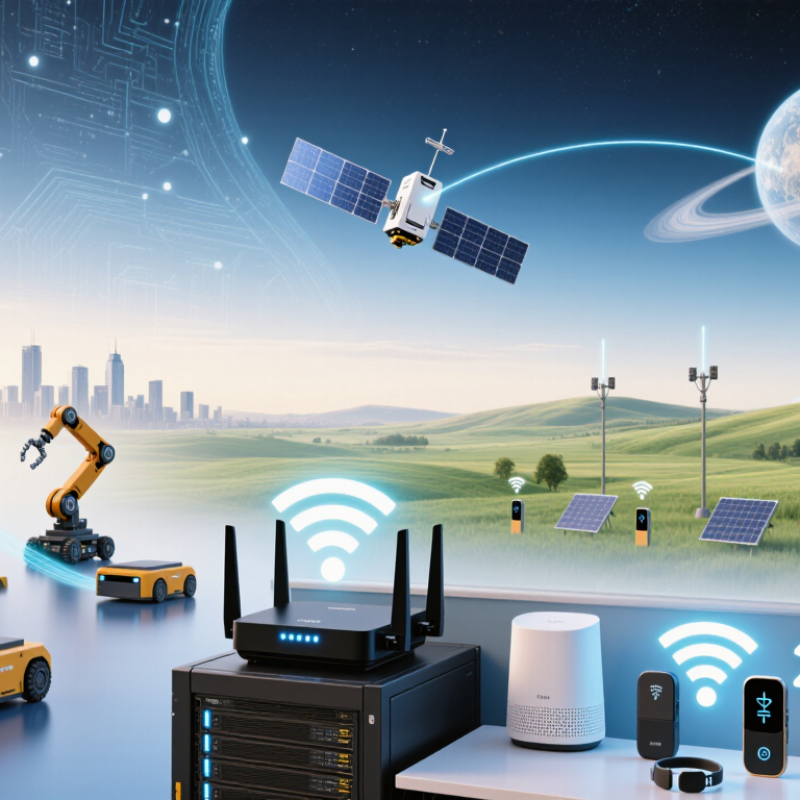
What Are the 2026 Top Wireless Transmission Device Types?
Wi-Fi 7 access points are expected to lead high-capacity wireless networks in 2026. The Wi-Fi Alliance reports a theoretical peak of up to 46 Gbit/s. This figure combines 320 MHz channels, 4096-QAM, and Multi-Link Operation. It is an impressive laboratory result. Real rooms will deliver less. Walls, interference, client hardware, and backhaul capacity still matter.
A 2024 ABI Research outlook identifies Wi-Fi 7 as one of the fastest-growing enterprise WLAN upgrades through 2029. The technology targets crowded offices, hospitals, campuses, and industrial facilities. Multi-Link Operation can use several bands at once. This may reduce latency during video, cloud, and automation workloads. However, installing faster access points cannot repair weak cabling. That assumption deserves more caution. IEEE 802.11be performance also depends on compatible client devices and careful radio planning.
Tips: Check wired uplinks before purchasing. Use spectrum surveys, not guesswork. Measure throughput at busy hours. Keep the 46 Gbit/s figure as a ceiling, not a promise. A practical deployment may gain more from better placement than from maximum specifications. Regular firmware reviews and security testing also support reliable operation.
| Wireless Device Type | Primary Standard or Technology | Typical Spectrum | Maximum Theoretical Data Rate | Typical Coverage or Link Distance | Common 2026 Applications | Key Technical Advantage |
|---|---|---|---|---|---|---|
| Wi-Fi 7 Access Point | IEEE 802.11be | 2.4 GHz, 5 GHz, and 6 GHz | Up to 46 Gbit/s aggregate theoretical throughput | Approximately 10–30 m indoors, depending on frequency, construction, and deployment | Multi-gigabit home and enterprise networking, wireless backhaul, cloud applications, industrial connectivity, and immersive media | 320 MHz channels, 4096-QAM, Multi-Link Operation, and improved latency management |
| Wi-Fi 6E Access Point | IEEE 802.11ax with 6 GHz extension | 2.4 GHz, 5 GHz, and 6 GHz | Up to 9.6 Gbit/s aggregate theoretical throughput | Approximately 10–30 m indoors; 6 GHz generally has shorter indoor reach than lower bands | High-density offices, residential broadband, wireless virtual reality, video production, and low-interference local networks | Additional 6 GHz spectrum, wider channels, OFDMA, and efficient operation in dense environments |
| 5G Fixed Wireless Access Gateway | 5G New Radio | Sub-1 GHz, mid-band, and millimeter-wave spectrum | Up to 20 Gbit/s downlink peak specified for IMT-2020 systems; commercial speeds are lower | From several hundred meters to several kilometers, depending on spectrum, site density, and line of sight | Residential broadband, temporary connectivity, rural access, branch offices, and backup Internet connections | Wide-area broadband without a wired last-mile connection |
| 5G Industrial Router | 5G New Radio with private-network capabilities | Licensed, shared, or locally authorized sub-6 GHz and millimeter-wave bands | Up to 20 Gbit/s downlink peak specified for IMT-2020 systems; practical rates vary by network design | Typically hundreds of meters to several kilometers in industrial deployments | Machine connectivity, automated guided vehicles, remote monitoring, video inspection, and edge computing | Mobility, network slicing support, low-latency options, and strong device density |
| 60 GHz Multi-Gigabit Access Point | IEEE 802.11ad or IEEE 802.11ay | Approximately 57–71 GHz, subject to regional regulation | Up to about 7 Gbit/s for 802.11ad and higher multi-gigabit rates for 802.11ay implementations | Usually 1–10 m indoors; performance is strongly affected by walls and obstructions | Wireless docking, room-scale device links, uncompressed video, and short-range backhaul | Very high capacity with low interference and highly directional transmission |
| Low-Power Wide-Area Gateway | LoRaWAN | Sub-GHz regional ISM bands | Approximately 0.3–50 kbit/s, depending on spreading factor, bandwidth, and regional configuration | Typically 2–15 km in rural areas and less in dense urban environments | Smart metering, agriculture, environmental monitoring, asset tracking, and building sensors | Very low power consumption and long range for small, infrequent data packets |
| Bluetooth Low Energy Gateway | Bluetooth Core Specification, LE 1M and LE 2M PHY | 2.4 GHz ISM band | Up to 2 Mbit/s over the air with the LE 2M PHY | Usually 10–100 m, depending on PHY mode, antenna, and environment | Wearables, asset beacons, medical sensors, smart locks, and device provisioning | Low energy use, broad device support, and optional long-range coded PHY modes |
| UWB Positioning Anchor or Gateway | IEEE 802.15.4z Ultra-Wideband | Typically 3.1–10.6 GHz, subject to regional rules | Up to approximately 27.2 Mbit/s in high-rate configurations | Commonly 10–50 m indoors, with precise ranging over shorter distances | Indoor positioning, access control, asset tracking, digital keys, and precision device discovery | Centimeter-level ranging potential and strong resistance to multipath interference |
| NFC Reader and Embedded Module | ISO/IEC 14443 and NFC Forum specifications | 13.56 MHz | Up to 424 kbit/s for common NFC data-transfer modes | Typically within 0–4 cm for reliable operation | Contactless payment, identity verification, access badges, pairing, and product authentication | Very short-range operation improves intentionality and supports passive tags |
| Satellite Broadband Terminal | Geostationary or non-geostationary satellite broadband systems | Primarily Ku-band and Ka-band, depending on the service architecture | Service-dependent; consumer terminals commonly range from tens to hundreds of Mbit/s | Regional or near-global coverage, subject to satellite footprint and terminal visibility | Remote broadband, emergency communications, maritime connectivity, aviation, and disaster recovery | Connectivity in areas where terrestrial networks are unavailable or damaged |
| Note: The figures above distinguish theoretical maximum rates from typical deployment performance. Actual throughput, range, latency, and power consumption depend on channel width, modulation, antenna design, interference, regulation, network topology, and environmental conditions. | ||||||
No. It is a peak downlink target under ideal conditions. Most users will experience less.
Spectrum width, antenna layers, signal conditions, and transport capacity all matter. Evening congestion can reduce speeds sharply.
Lower frequencies usually cover wider areas but offer narrower channels. Higher frequencies can deliver more speed but travel less effectively.
Sometimes, but only near a strong, dense site. Concrete walls, distance, and interference may reduce performance.
No. That figure usually assumes open terrain and favorable conditions. Hills, buildings, weather, and antenna height change the result.
They should survey elevation, interference, power access, and device positions. Simple field tests often expose gaps on coverage maps.
Mount the gateway above nearby obstacles when possible. Use weather protection, grounding, and a sensible safety margin.
They can connect devices in oceans, deserts, mountains, and disaster zones. Clear sky views and careful power control remain necessary.
Setup may take longer, and batteries may drain faster. Forests, buildings, rain, latency, and handovers can weaken service.
No. It adds coverage but cannot guarantee seamless service everywhere. I would question any design promising perfect connectivity.
In 2026, the Wireless Transmission Device market will include a broad range of technologies designed for different coverage, speed, and connectivity needs. Wi-Fi 7 access points may deliver aggregate speeds of up to 46 Gbit/s, supporting high-density homes, offices, and industrial environments. 5G radio units are expected to offer peak downlink performance near 20 Gbit/s under advanced mobile-network targets, enabling faster communications and lower-latency services. Bluetooth Low Energy devices will continue to provide efficient short-range connections, with a defined physical-layer rate of up to 2 Mbit/s.
For wider-area applications, LoRaWAN gateways can support rural communication across distances of up to 15 kilometers, making them useful for agriculture, environmental monitoring, and smart infrastructure. Meanwhile, non-terrestrial network satellite terminals, supported by newer 5G specifications, will extend connectivity beyond traditional ground-based networks. Together, these device types demonstrate how wireless transmission is evolving toward greater speed, broader coverage, lower power consumption, and more flexible access in both urban and remote environments.

 Sinosun Tech