2026 Best Data Transmission Radio Types for Global Buyers

Time:2026-10-03 Author:Henry
0%

Choosing the right Data Transmission Radio in 2026 requires more than comparing advertised range. Global buyers must match radio architecture with terrain, data volume, power limits, network availability, and local spectrum rules. A warehouse sensor may need short-range, low-power communication. A mining site may require long-distance links across rock, dust, and changing weather. The “best” radio depends on the operating environment.

Industry data shows why this decision matters. IoT Analytics reported approximately 18.8 billion connected IoT devices worldwide in 2024, with further growth expected across industrial and commercial markets. Ericsson’s Mobility Report also described continuing expansion in 5G subscriptions and network coverage, supporting cellular options for mobile and high-throughput applications. Meanwhile, the ITU continues emphasizing efficient spectrum use, interference management, and regional coordination. These findings point to a practical reality: connectivity demand is growing, but available spectrum is not unlimited.

This guide compares major radio types used for global data transmission, including UHF, VHF, Wi-Fi, cellular, LoRaWAN, and satellite systems. It considers range, throughput, latency, battery life, installation complexity, security features, and total ownership cost. Technical datasheets can look precise. Field performance may differ. Antennas, obstacles, humidity, firmware, and network congestion often change the result.

There is no universal winner.

Buyers should verify certification, supported bands, regional approvals, and supplier service before placing large orders. A low purchase price may conceal replacement batteries, subscription fees, or difficult maintenance. This overview offers a structured starting point, while site testing remains essential for reliable deployment.
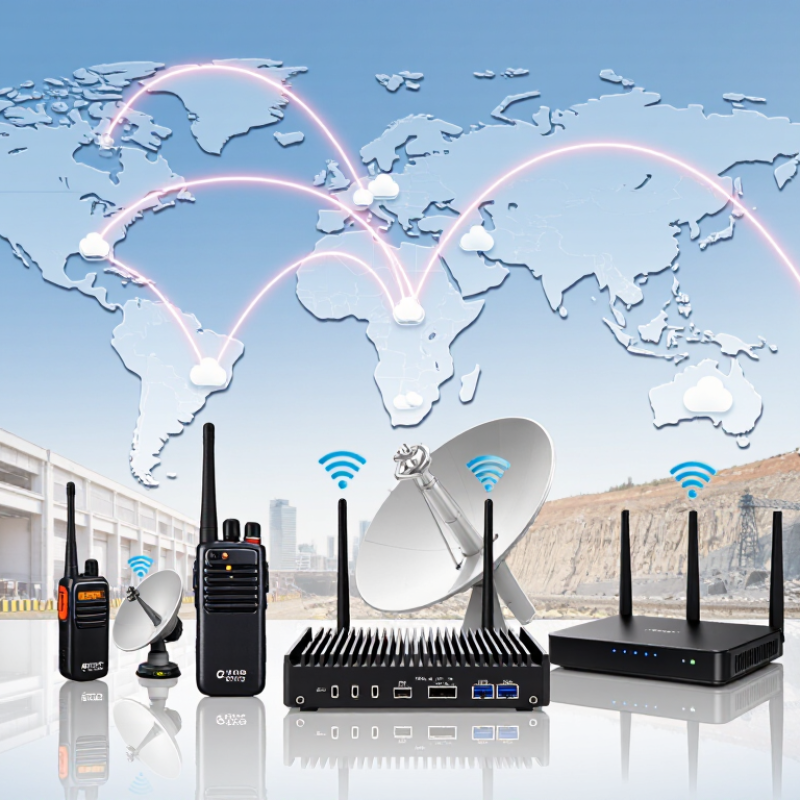
2026 Best Data Transmission Radio Types for Global Buyers

Classify Data-Transmission Radios by Range, Spectrum, and Throughput

For global buyers in 2026, data-transmission radios should be classified by range, spectrum, and throughput, not distance claims alone. Short-range models usually support nearby sensors, machines, or meters within buildings. Mid-range radios can connect facilities across several kilometres with suitable antennas. Long-range systems may cover much farther, but terrain, antenna height, weather, and installation quality strongly affect performance. Distance changes everything.

Spectrum selection influences reliability, cost, and regulatory approval. Unlicensed sub-GHz spectrum often offers useful building penetration and simpler deployment, although interference may increase in busy areas. Higher-frequency bands can provide faster data rates but may require clearer paths. Licensed spectrum can deliver more predictable operation, yet buyers must confirm national frequency allocations, power limits, and equipment certification before purchase. Regional rules vary.

Throughput should match the real workload. Low-throughput radios suit temperature readings, alarms, and periodic status messages. Higher-throughput equipment supports firmware updates, images, industrial records, or continuous monitoring. However, advertised data rates rarely equal application throughput. Protocol overhead, retransmissions, encryption, network congestion, and weak signals reduce usable capacity. Numbers need context. A practical evaluation should measure latency, packet loss, connection recovery, and power consumption under realistic conditions. Field tests often expose assumptions that laboratory figures hide, and even a carefully designed plan may need revision after installation.

Short-Range Radios: Wi-Fi 7 (46 Gbit/s) vs Bluetooth LE (2 Mbit/s)

For global buyers, short-range radio selection begins with the workload, not the headline speed. Wi-Fi 7 can advertise up to 46 Gbit/s under ideal, multi-link conditions. Real throughput is usually lower. Walls, interference, channel width, and client hardware reduce performance quickly. A warehouse camera may need stable high-bandwidth links, while a handheld sensor may send only a few bytes each minute.

Bluetooth LE offers a maximum physical-layer rate of about 2 Mbit/s in its faster mode. Its practical throughput is lower, but that is often enough for temperature readings, control commands, and nearby device discovery. It also supports low power operation. A small battery-powered tag can remain useful for months, depending on connection intervals and measurement frequency. Wi-Fi usually demands more energy and stronger thermal management.

The difference feels obvious during testing. A Wi-Fi 7 laptop can move a large inspection video in seconds. A Bluetooth LE node may transfer a short status packet almost unnoticed. However, a crowded office can make high-speed Wi-Fi less predictable. Bluetooth LE can also suffer from congestion and limited range. Test both systems inside the intended building, behind real walls, with the final antennas and firmware. Do not trust laboratory peaks alone. I have seen impressive radio specifications fail when metal shelves, sleeping devices, or battery limits entered the design. That uncertainty deserves a budget.

2026 Best Data Transmission Radio Types for Global Buyers

Short-Range Radios: Wi-Fi 7 (46 Gbit/s) vs Bluetooth LE (2 Mbit/s)

This comparison uses published maximum theoretical physical-layer data rates. Wi-Fi 7 supports up to 46,000 Mbit/s under ideal conditions, while Bluetooth Low Energy supports up to 2 Mbit/s. Actual throughput depends on distance, interference, channel configuration, device capability, and protocol overhead.

LPWAN Radios: LoRaWAN (0.3–50 kbit/s) vs NB-IoT (127 kbit/s)

2026 Best Data Transmission Radio Types for Global Buyers

LPWAN Radios: LoRaWAN (0.3–50 kbit/s) vs NB-IoT (127 kbit/s)

For global IoT buyers, throughput is only one part of the decision. LoRaWAN typically supports 0.3–50 kbit/s, depending on spreading factors, region, and signal conditions. NB-IoT can reach about 127 kbit/s under suitable network conditions. These figures describe maximum or theoretical performance, not guaranteed application speed. Real payloads lose capacity through protocol overhead, repetition, and weak coverage.

LoRaWAN often fits battery sensors sending small packets, such as soil readings, meter values, or warehouse temperatures. Its low duty cycle can support long battery life and private network deployment. NB-IoT suits devices needing stronger operator-managed coverage, better downlink capability, or more frequent communication. 3GPP specifications support its cellular-grade architecture, while GSMA Intelligence projects global IoT connections could reach 29.7 billion by 2030. That growth increases the value of scalable network planning. Still, the stated 127 kbit/s can disappoint when indoor penetration or network congestion is poor.

Tips: Test both radios inside the target building, not only outdoors. Measure delivery rate, latency, battery drain, and monthly service cost. Check regional spectrum rules before purchasing. A pilot with real sensors is safer than trusting a laboratory chart. I would also question battery estimates; cold weather and repeated retries can change them sharply.

2026 Best Data Transmission Radio Types for Global Buyers - LPWAN Radios: LoRaWAN (0.3–50 kbit/s) vs NB-IoT (127 kbit/s)

Evaluation Dimension LoRaWAN NB-IoT Buyer-Oriented Interpretation
Technology Category Low-power wide-area networking protocol using spread-spectrum radio modulation. Cellular IoT radio technology standardized for narrowband machine-type communications. Choose based on the available network model, coverage requirements, and deployment responsibility.
Typical Data Rate Approximately 0.3–50 kbit/s, depending on regional channel plans, bandwidth, spreading factor, and radio conditions. Up to approximately 127 kbit/s downlink and 158.5 kbit/s uplink under specified peak conditions. NB-IoT offers a higher peak rate, while LoRaWAN is generally intended for small and infrequent messages.
Typical Message Pattern Small sensor readings, status updates, alarms, and control commands. Sensor data, alarms, tracking information, metering messages, and more frequent device communication. Neither technology is designed for video, voice, continuous streaming, or large file transfer.
Radio Spectrum Usually operates in license-exempt sub-GHz bands; the exact band depends on the country or region. Operates in licensed cellular spectrum, using in-band, guard-band, or standalone deployment options where supported. Check national frequency rules before selecting hardware for international shipments.
Network Infrastructure Requires compatible gateways connected to a network server; private, public, or hybrid deployments are possible. Requires a compatible cellular network and an authorized subscriber identity or service arrangement. LoRaWAN can provide greater local infrastructure control; NB-IoT can simplify wide-area connectivity where service is available.
Coverage Characteristics Long-range outdoor coverage is possible, with performance strongly affected by gateway placement, antenna design, terrain, and spreading factor. Uses cellular infrastructure and enhanced coverage modes designed for difficult indoor and underground locations. NB-IoT may be preferable for deployments that need established cellular coverage; LoRaWAN is attractive where gateways can be installed strategically.
Maximum Coupling Loss Commonly specified around 157 dB for the highest spreading-factor mode, depending on the regional profile and implementation. Up to approximately 164 dB in enhanced coverage modes, depending on the operating mode and network configuration. These are radio-link design values, not guaranteed indoor range distances.
Power Consumption Profile Very low power for devices that transmit small packets occasionally; Class A is generally the most energy-efficient operating class. Low power when using power-saving features such as extended discontinuous reception and power-saving mode, but cellular procedures can require more energy during communication. Battery life depends on message size, reporting interval, signal conditions, receive windows, retries, and sleep configuration.
Latency Variable and generally higher when using low-data-rate settings, duty-cycle restrictions, or scheduled downlink opportunities. Variable; connection setup, coverage enhancement, paging, and power-saving settings can introduce substantial delay. Use application-level buffering and acknowledgements when the product requires reliable delivery rather than immediate response.
Downlink Capability Limited by receive windows, device class, regional duty-cycle rules, and network capacity. Supports scheduled cellular downlink communication, subject to network configuration, coverage, and device power settings. NB-IoT is usually better for applications requiring more regular downlink communication.
Mobility Support Best suited to fixed or slowly changing locations; roaming and handover behavior depends on the network architecture. Supports cellular mobility features, although it is primarily optimized for low-throughput IoT rather than high-speed mobility. For moving assets, verify network support, roaming availability, antenna performance, and location-service requirements.
Device Authentication and Security Uses network and application security mechanisms, including AES-128-based cryptographic protection and separate network/application session concepts. Uses cellular security architecture, including subscriber authentication, encryption, and integrity protection defined by cellular standards. Security also depends on key management, firmware updates, backend protection, and secure device provisioning.
Payload Efficiency Payload capacity varies by regional data rate and spreading factor; lower data rates generally permit smaller application payloads. Supports larger and faster transfers than low-rate LoRaWAN configurations, but radio and network limits still apply. Estimate the complete transaction size, including headers, acknowledgements, retries, and firmware-update traffic.
Regulatory Considerations Subject to regional unlicensed-band rules, including transmit-power limits, channel plans, and duty-cycle or dwell-time requirements. Subject to national cellular approvals, operator certification, supported bands, and applicable radio regulations. Global products may require different radio configurations, antennas, certifications, or regional variants.
Best-Fit Applications Smart metering, environmental monitoring, agriculture, building sensors, asset status monitoring, and private industrial networks. Utility metering, city infrastructure, industrial monitoring, cellular-connected sensors, and deployments requiring managed wide-area coverage. Match the technology to message frequency, coverage ownership, mobility, service availability, and total operating cost.
Primary Advantages Flexible private deployment, low device cost potential, low energy use for small messages, and broad ecosystem interoperability. Managed cellular coverage, stronger standardized mobility support, licensed-spectrum operation, and higher peak throughput. LoRaWAN favors deployment control and simple low-volume sensing; NB-IoT favors operator-managed connectivity and cellular reach.
Main Limitations Low throughput, downlink constraints, regional spectrum differences, gateway planning requirements, and possible duty-cycle limitations. Operator dependence, subscription or service costs, network availability requirements, module complexity, and potentially higher energy use. Run a field test with the final enclosure, antenna, battery, reporting interval, and installation environment before mass production.
Recommended Selection Rule for 2026 Select when the product sends small, delay-tolerant messages and the buyer needs private or locally managed network control. Select when reliable cellular-area coverage, managed connectivity, mobility support, or higher peak throughput is more important. For global procurement, confirm regional band support, certification, network availability, module lifecycle, and total cost of ownership.

Technical note: Actual performance varies with region, spectrum configuration, antenna design, network implementation, coverage conditions, device firmware, and regulatory limits. Peak data rates are not guaranteed application throughput.

Cellular Radios: 5G IMT-2020 (20 Gbit/s) and LTE Cat 1 bis

For global buyers, cellular radios must match the application, coverage plan, and data workload. 5G IMT-2020 radios can reach theoretical speeds near 20 Gbit/s under ideal conditions. Real deployments usually deliver less. Buildings, spectrum limits, distance, and network congestion change performance.

These radios suit video monitoring, industrial imaging, cloud robotics, and other demanding systems. A factory camera may upload high-resolution footage within seconds. Low latency can also support faster machine coordination. However, buyers should check regional bands, antenna design, power consumption, and certification requirements before ordering. Peak speed alone is not enough.

LTE Cat 1 bis offers a simpler path for moderate data needs. It typically supports reliable single-antenna connectivity for trackers, meters, alarms, and payment terminals. Hardware can be smaller and easier to integrate. It may also reduce power and antenna complexity. Coverage remains the key question. A remote meter cannot benefit from speed it cannot maintain. Engineers should test signal strength inside metal cabinets, vehicles, and concrete rooms. Field results often differ from laboratory sheets. That difference matters. LTE Cat 1 bis may be the better value for stable telemetry, while 5G suits heavier traffic and stricter latency targets. Still, this decision is not permanent; networks, tariffs, and device requirements can change during a product’s service life.

Global Buyer Checklist: Power, Bands, Certification, and Total Cost

2026 Best Data Transmission Radio Types for Global Buyers

Choosing a data transmission radio starts with the application, not the product label. Short-range equipment may suit warehouses, while long-range radios help remote monitoring. Cellular, mesh, and sub-GHz systems each solve different coverage problems. During field testing, I have seen strong specifications fail because metal walls weakened signals. Power planning matters equally. Check transmit power, sleep modes, duty cycles, battery chemistry, and solar performance. A radio that lasts six months on paper may last three months outdoors.

Confirm operating bands for every target market. Regional spectrum rules differ, and a frequency accepted in one country may require approval elsewhere. Request test reports, conformity documents, labeling details, and regional certification evidence before placing a large order. Do not rely only on a supplier’s general statement. Ask whether the approval covers the exact frequency, antenna, firmware, and power setting. Details change.

Tips: Build a small pilot with real antennas and typical traffic. Measure range, latency, packet loss, and battery drain. Keep written test records. Estimate total cost beyond the unit price, including gateways, antennas, installation, SIM plans, certification work, shipping, maintenance, and software updates. I once underestimated replacement antennas, and the budget shifted quickly. A lower initial quote is not always cheaper. Recheck assumptions with local engineers and compliance professionals, because even careful planning can miss an inconvenient regional requirement.

FAQS

How do low-power wide-area radios compare with cellular IoT radios?

Low-power wide-area radios usually deliver about 0.3–50 kbit/s. Cellular IoT radios can reach roughly 127 kbit/s under suitable conditions. These are theoretical figures, not guaranteed application speeds.

Which radio type suits battery-powered sensors?

Low-power wide-area radios often suit soil, meter, and warehouse temperature sensors. They send small packets and may support long battery life. Cellular IoT radios suit more frequent communication and stronger managed coverage.

Can advertised data rates be trusted?

Not completely. Protocol overhead, repeated transmissions, weak signals, and congestion reduce usable speed. A laboratory chart may look excellent. Real buildings can disagree.

What should buyers measure during testing?

Test delivery rate, latency, packet loss, and battery drain. Use real sensors, antennas, and normal traffic. Test inside the target building, not only outdoors.

How do buildings affect radio performance?

Metal walls, concrete, and indoor equipment can weaken signals. Poor penetration may increase retries and delay messages. A basement test could reveal more than an outdoor range claim.

What power details require attention?

Check transmit power, sleep modes, duty cycles, battery chemistry, and solar performance. Cold weather may shorten battery life. Repeated retries can drain batteries quickly.

What regional requirements should global buyers verify?

Confirm operating bands and spectrum rules in every target market. Request documents covering the exact frequency, antenna, firmware, and power setting. Approval details can change.

How should total cost be calculated?

Include gateways, antennas, installation, service plans, certification work, shipping, maintenance, and software updates. The lowest unit price may not be the lowest project cost. I once underestimated replacement antennas. That mistake was expensive.

Conclusion

Choosing the right Data Transmission Radio in 2026 requires balancing range, spectrum, throughput, power use, and total cost. Short-range options can deliver extremely high speeds, with next-generation local wireless systems reaching up to 46 Gbit/s, while low-energy personal-area radios may provide around 2 Mbit/s for sensors and accessories. For long-distance, low-power deployments, LPWAN technologies typically range from 0.3 to 50 kbit/s, while cellular IoT connections can reach approximately 127 kbit/s and support broader coverage.

For higher-performance applications, modern cellular systems can offer peak rates of up to 20 Gbit/s, while simpler LTE-based categories are suitable for reliable, cost-sensitive devices. Global buyers should compare operating bands, regional certification requirements, antenna design, energy consumption, network availability, security features, and lifecycle expenses. The best selection is not always the fastest radio; it is the one that matches the required distance, data volume, battery life, deployment environment, and long-term operating budget.

Henry

Henry

Henry is a dedicated marketing professional with a profound expertise in the company's offerings. With years of experience in the industry, he possesses an impressive understanding of the market dynamics and consumer behaviors that drive success. Henry is committed to sharing his insights through......